




# What Is A Commodity Chain? The Expert Guide To Understanding Global Production
Have you ever wondered how the coffee in your morning cup traveled from a farm in Colombia to your kitchen? Or how the components in your smartphone were assembled across multiple continents before reaching your pocket? The answer lies in a fundamental concept of our globalized economy: the commodity chain. Understanding what a commodity chain is provides a powerful lens to see the world, revealing the intricate, often hidden, connections between producers, consumers, and the environment. This guide will break down this essential concept, explore its different types, and show you how to analyze the real-world impact of the products you use every day.
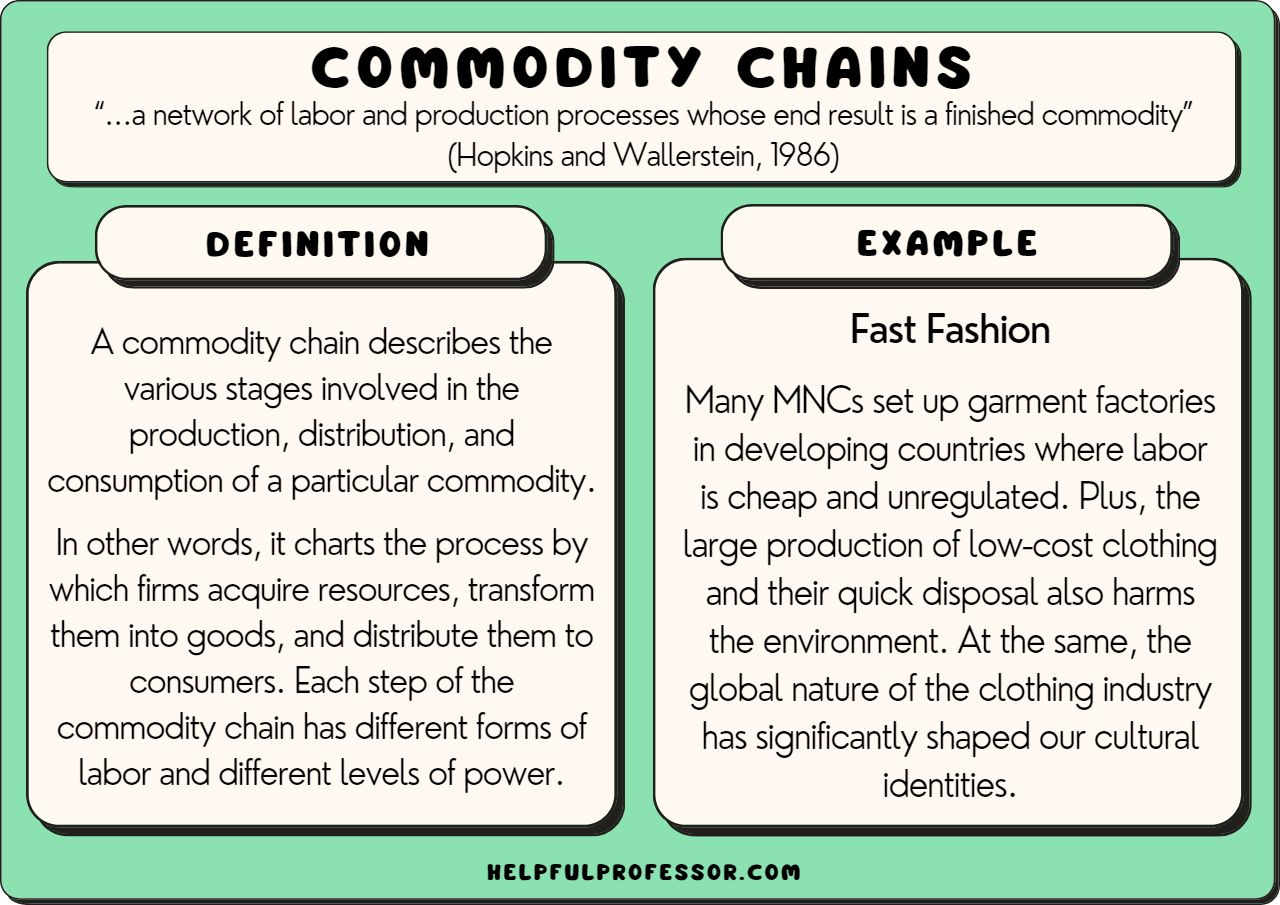
At its core, a commodity chain is the complete process network that describes how a good or service is created, transformed, and delivered to the end consumer. It traces the journey from the initial raw materials, through various stages of production and assembly, to distribution, retail, and final consumption. Each link in this chain adds value and involves different actors, from farmers and factory workers to logistics companies and marketing firms. The study of commodity chains helps us move beyond seeing a product as just a finished item, instead viewing it as the result of a complex, globally dispersed social and economic process.
## The Anatomy Of A Commodity Chain: Key Links And Actors
To fully grasp what a commodity chain is, we need to dissect its typical components. While chains vary by product, most follow a similar structural pattern.
The first link is INPUTS AND RAW MATERIALS. This includes the extraction of natural resources like minerals, oil, timber, or the cultivation of agricultural products like cotton, cocoa, or wheat. The second link is PRODUCTION AND MANUFACTURING. Here, raw materials are processed, refined, and assembled into components or final goods. This stage often involves multiple factories in different countries, each specializing in a specific task. The third critical link is DISTRIBUTION AND LOGISTICS. This encompasses the transportation, warehousing, and wholesale networks that move goods across vast distances. The final link is MARKETING, RETAIL, AND CONSUMPTION. This is where branding, advertising, and sales channels connect the product to you, the consumer.
Crucially, a commodity chain is not just a physical pathway. It is governed by a structure of POWER and COORDINATION. There is almost always a “lead firm” that controls the chain, setting standards, prices, and terms. In the smartphone industry, this is typically the brand like Apple or Samsung. In agriculture, it might be a massive food conglomerate. These firms capture the largest share of the value, even if they own few of the physical production facilities themselves. According to a 2020 OECD report, global value chains account for nearly 70% of international trade today, highlighting their dominance in the world economy.
## Types Of Commodity Chains: Producer-Driven vs. Buyer-Driven
Not all commodity chains are organized in the same way. Scholars, particularly Gary Gereffi, have identified two primary types, which are best understood through a direct comparison.
| Aspect | Producer-Driven Commodity Chain | Buyer-Driven Commodity Chain |
|---|---|---|
| DEFINING INDUSTRY | Capital and technology-intensive (e.g., automobiles, aircraft, semiconductors) | Labor-intensive consumer goods (e.g., apparel, footwear, toys, home goods) |
| CONTROL POINT | Large manufacturing multinationals (e.g., Toyota, Boeing, Intel) | Large retailers, marketers, and branded manufacturers (e.g., Walmart, Nike, IKEA) |
| SOURCE OF POWER | Control over production technology, capital, and manufacturing expertise | Control over design, branding, and access to consumer markets |
| BARRIERS TO ENTRY | Extremely high (requires massive capital investment) | Relatively low for production, high for branding and retail |
| TYPICAL STRUCTURE | Vertically integrated or tightly controlled supplier networks | Decentralized, global network of independent contract factories |
This distinction is crucial. When you analyze a product, ask: who is calling the shots? Is it the company that owns the factory, or the company that owns the brand and the customer relationship? For example, the apparel industry is a classic buyer-driven chain. A company like Nike focuses on design, marketing, and sales, while outsourcing nearly all physical production to a sprawling network of contractors in countries like Vietnam, Indonesia, and Bangladesh. This model allows for immense flexibility and cost reduction but also creates challenges in ensuring labor and environmental standards are met throughout the chain.
## A 5-Step Guide To Mapping Any Commodity Chain
Want to uncover the hidden story behind a product? You can conduct a basic commodity chain analysis yourself. Here is a practical, five-step guide to get you started.
STEP 1: SELECT YOUR COMMODITY. Choose a specific, everyday item. “A smartphone” is too broad. Try “the aluminum casing for a specific smartphone model” or “a cotton t-shirt from a specific brand.” The more specific, the clearer your analysis.
STEP 2: TRACE BACKWARD FROM CONSUMPTION. Start with the finished product in the store. Who is selling it? Where was it shipped from? Look for “Made in” labels, but understand this is only the final assembly point.
STEP 3: IDENTIFY CORE PRODUCTION AND PROCESSING STAGES. Research where the main components or materials come from. For the t-shirt, this means identifying where the cotton was grown, where it was spun into yarn, where the yarn was woven into fabric, and where the fabric was cut, sewn, and dyed. Company sustainability reports and investigative journalism are good sources here.
STEP 4: IDENTIFY THE KEY ACTORS AND POWER DYNAMICS. List the major companies involved at each stage. Who sets the prices and standards? Is there a dominant retailer or brand? Is there a powerful supplier of a key raw material? This reveals the governance structure.
STEP 5: ANALYZE THE GEOGRAPHIC AND SOCIAL DIMENSIONS. Map the physical journey. How many countries were involved? What are the labor conditions, wage levels, and environmental regulations at different points? This step reveals the chain’s human and ecological footprint. A study by the International Labour Organization estimates that over 160 million children are engaged in child labor globally, many within complex agricultural and manufacturing commodity chains.
## Common Misconceptions And Critical Warnings
When learning what a commodity chain is, several pitfalls can lead to an oversimplified understanding.
WARNING: DO NOT CONFUSE A COMMODITY CHAIN WITH A BASIC SUPPLY CHAIN. While related, a supply chain focuses narrowly on the logistics, efficiency, and flow of materials. A commodity chain analysis is broader, incorporating the sociological, economic, and political dimensions of power, value distribution, and labor relations. It asks not just “how” something moves, but “who benefits” and “who bears the cost.”
Another major misconception is viewing the chain as a linear, neat sequence. In reality, commodity chains are messy networks. A single factory may supply multiple brands. Materials may loop back for recycling. The digital services supporting logistics are an integral part of the chain. Furthermore, the idea that “globalization has made the chain longer” is not always true. For some products, like regional food, there is a push for shorter, more localized chains.
Perhaps the most critical insight from my experience as a researcher is this: the places where the most physical work and environmental impact occur are often where the least financial value is captured. The farmer growing coffee beans or the miner extracting cobalt receives a minuscule fraction of the final product’s price. This value asymmetry is the central ethical and economic question posed by commodity chain analysis.
## The Future And Your Role: From Analysis To Action
Understanding commodity chains is not an academic exercise. It empowers you to be a more conscious consumer and citizen. Movements for ethical fashion, fair trade coffee, and conflict-free minerals are all rooted in commodity chain analysis. They seek to create more equitable, transparent, and sustainable chains.
Brands are increasingly being held accountable for their entire chain, not just their direct operations. Legislation like the UK Modern Slavery Act and the proposed EU Corporate Sustainability Due Diligence Directive forces large companies to examine and report on their supply networks. This creates leverage for change. As a consumer, you can support companies that provide genuine transparency and invest in better practices from farm to factory to store.
So, what is a commodity chain? It is the story of our stuff. It is a map of global interconnection, a diagram of power, and a tool for building a better economy. By learning to see these chains, we take the first step toward shaping them.
CHECKLIST FOR COMMODITY CHAIN AWARENESS:
IDENTIFY THE LEAD FIRM in the chain for your favorite products.
RESEARCH THE COUNTRY OF ORIGIN for primary materials, not just final assembly.
SUPPORT BRANDS that provide transparent supplier lists and audit reports.
ADVOCATE FOR STRONGER CORPORATE DUE DILIGENCE laws in your region.
REDUCE CONSUMPTION of fast-moving goods known for opaque and exploitative chains.
EDUCATE OTHERS on the basic concept of the commodity chain to spread awareness.