






# The Ultimate Guide to the Digital Media Supply Chain: 5 Steps to Modernize Your Workflow
The term digital media supply chain is everywhere, but what does it truly mean for your business. At its core, it is the entire journey a piece of content takes from creation to consumption. This includes every step, person, and piece of technology involved. Think of it as a complex, global factory line for videos, images, podcasts, and articles. A modern digital media supply chain is not just about moving files. It is about managing metadata, ensuring security, automating workflows, and delivering personalized experiences at scale.
For many organizations, this chain is a tangled mess of manual processes and disconnected tools. This leads to wasted time, ballooning costs, and missed opportunities. A report by Accenture found that media companies lose up to 30 percent of their potential revenue due to supply chain inefficiencies. That is a staggering number. This guide will break down the digital media supply chain into understandable parts. We will provide a clear roadmap to optimize it, making your content operations faster, cheaper, and more effective.
UNDERSTANDING THE MODERN DIGITAL MEDIA SUPPLY CHAIN
The old model was linear and simple. Create, edit, distribute. The modern digital media supply chain is a dynamic ecosystem. It is a continuous loop driven by data and automation. The goal is to create a single asset once and then reuse, repurpose, and redistribute it across countless platforms and formats. This requires a fundamental shift in thinking. Content is no longer a final product but a dynamic data set with rich metadata attached.
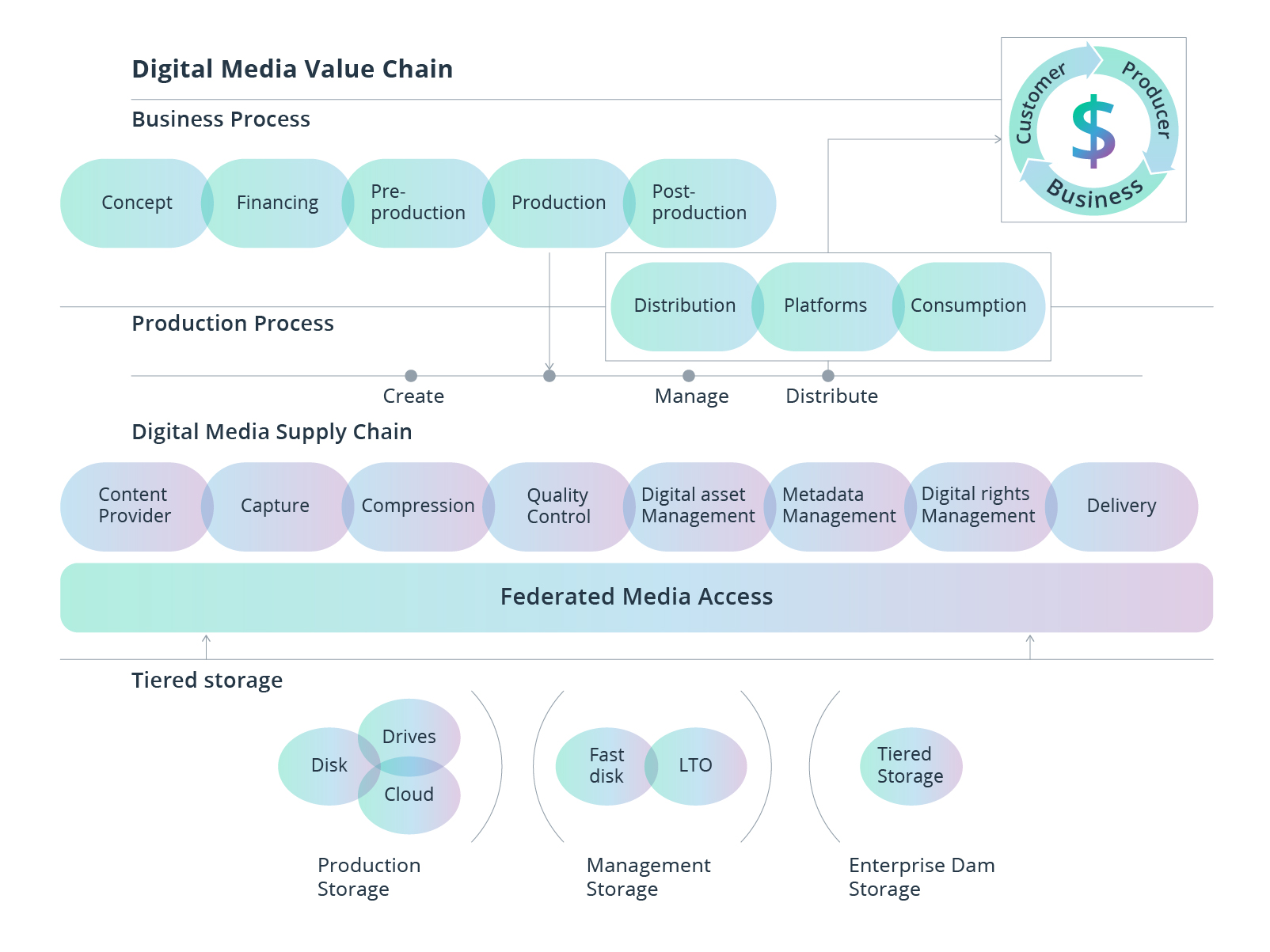
Key components of this ecosystem include:
– Creation and Ingestion: Where raw content is generated and brought into the system.
– Asset Management: The central library, often a Media Asset Management (MAM) system, where files and their metadata live.
– Production and Post-Production: Editing, versioning, and finishing, increasingly happening in the cloud.
– Quality Control and Compliance: Automated checks for technical specs, content rights, and regulatory standards.
– Distribution and Delivery: Pushing content to broadcasters, streaming platforms, social media, and archives.
– Analytics and Optimization: Measuring performance to inform future creation and distribution strategies.
The glue holding this together is metadata. Without accurate, searchable metadata, assets become lost in a digital black hole. The entire digital media supply chain depends on this data to automate workflows and make content discoverable.
COMMON PITFALLS AND WARNING SIGNS
Many companies struggle with their media logistics without realizing the root cause. Here are the major warning signs your digital media supply chain is broken.
First, you experience constant version confusion. Teams waste hours searching for the right cut or the final approved master. Second, manual processes dominate. If your team is manually uploading files to multiple platforms or filling out spreadsheets to track rights, you are losing money. Third, you cannot scale. Handling ten videos is manageable. Handling ten thousand is impossible with ad-hoc methods. Fourth, you lack visibility. You have no clear picture of where an asset is, who is working on it, or what its performance has been.
A critical mistake is treating technology as a silver bullet. Buying a new MAM or workflow tool without first mapping and streamlining your processes will only automate chaos. Another major error is neglecting metadata strategy from the start. Tagging assets as an afterthought is a recipe for failure. According to a study by the Content Marketing Institute, 65 percent of the most successful content marketers have a documented content strategy, which includes governance around metadata and asset management. Your digital media supply chain needs the same level of strategic planning.
TECHNOLOGY SHOWDOWN: BUILDING YOUR MODERN STACK
Choosing the right technology is crucial. The market offers everything from monolithic suites to best-of-breed point solutions. Your choice depends on your scale, complexity, and budget. Below is a comparison of two common approaches.
| Feature / Aspect | All-in-One Suite (e.g., Cloud Playout & MAM) | Best-of-Breed Integrated Stack |
|---|---|---|
| Core Advantage | Simplified vendor management, native integration between modules, single point of support. | Superior functionality in each area, flexibility to choose market leaders, avoid vendor lock-in. |
| Integration Depth | High. Components are designed to work together seamlessly from the start. | Variable. Depends on API quality and middleware; can require custom development. |
| Cost Structure | Often a predictable subscription or license fee covering multiple capabilities. | Can be higher total cost due to multiple licenses and integration maintenance. |
| Best For | Organizations seeking simplicity, faster initial setup, and less technical overhead. | Large enterprises with complex, specific needs where no single suite excels at everything. |
| Risk | Being tied to one vendor’s roadmap and potential limitations in specific modules. | Integration complexity becoming a ongoing burden and potential point of failure. |
In our team’s experience consulting for mid-sized broadcasters, we often recommend starting with a strong cloud-based MAM as the central hub. This becomes the single source of truth for your assets. You can then integrate best-of-breed tools for editing, quality control, and distribution via APIs. This hybrid approach offers a good balance of control and capability.
YOUR 5-STEP ACTION PLAN TO OPTIMIZE THE SUPPLY CHAIN
Optimization does not happen overnight. Follow this actionable, step-by-step guide to build a more resilient and efficient digital media supply chain.
Step 1: Audit and Map Your Current State.
Do not buy anything yet. Document every single touchpoint for a typical asset. Identify all manual handoffs, bottlenecks, and redundant storage locations. Create a visual map. You will be shocked at the complexity you uncover.
Step 2: Define Your Metadata Schema.
Before implementing any tool, decide what metadata is mandatory for every asset. This includes technical data (codec, resolution), descriptive data (title, keywords), and administrative data (rights, usage restrictions). Standardize terms and enforce this schema from the moment of ingestion.
Step 3: Centralize Your Assets.
Choose a primary, cloud-based repository. This could be a dedicated MAM or a configured cloud storage solution with strong metadata capabilities. The goal is to eliminate asset silos. All new content must flow here, and a plan must be made to migrate legacy archives.
Step 4: Automate One High-Volume Workflow.
Do not try to automate everything at once. Pick a repetitive, high-volume process. A great example is the social media clip workflow. Set up an automated process where a long-form video is ingested, chapters are detected, short clips are auto-created with branding, and they are pushed to a review queue before scheduled publishing.
Step 5: Establish Governance and KPIs.
Assign clear ownership for the digital media supply chain. Define how you will measure success. Key Performance Indicators (KPIs) could include time-to-market for new content, cost per asset processed, or asset reuse rate. Review these metrics regularly to guide continuous improvement.
THE FUTURE: AI AND BEYOND
The next evolution of the digital media supply chain is intelligent and predictive. Artificial intelligence and machine learning are moving from buzzwords to essential tools. AI can automate logging, generate descriptive metadata, create subtitles, and even suggest edit points. More advanced systems can analyze content performance and predict what type of content will resonate on which platform, feeding insights directly back to the creation team.
This creates a truly responsive and efficient content lifecycle. The digital media supply chain becomes a competitive advantage, enabling personalized content at a global scale. The companies that invest in this intelligent infrastructure today will be the leaders of tomorrow.
IMPLEMENTATION CHECKLIST
To ensure your digital media supply chain project is set up for success, use this practical checklist. Complete each item before moving to the next phase.
– Conduct a full audit of current content workflows and pain points.
– Secure executive sponsorship and define a clear project budget.
– Assemble a cross-functional team from content, IT, and operations.
– Document a core metadata schema with mandatory and optional fields.
– Evaluate technology solutions against your mapped requirements, not vendor hype.
– Start with a pilot project focusing on a single, defined workflow.
– Develop a change management and training plan for all users.
– Define measurable KPIs to track ROI and operational improvement.
– Plan for ongoing maintenance, software updates, and process refinement.
– Foster a culture of continuous feedback and optimization from users.
By following this guide, you transform your digital media supply chain from a cost center into a strategic engine. You will unlock faster time-to-market, reduce operational waste, and ultimately create more value from every piece of content you produce. The journey requires commitment, but the rewards for your audience and your bottom line are substantial.