





# The Ultimate Guide to the Definition of Luxury Goods in Economics: 5 Key Characteristics Explained
What exactly is the definition of luxury goods in economics? It is a question that goes beyond price tags and brand names. In economic theory, a luxury good has a very specific meaning tied to consumer behavior. The core definition is a good for which demand increases more than proportionally as income rises. This relationship is measured by a concept called income elasticity of demand. For a luxury good, this elasticity is greater than one. In simpler terms, when people get richer, they spend a disproportionately larger share of their new wealth on these items. Understanding this definition is crucial for marketers, investors, and anyone analyzing market trends. This guide will break down the economic definition of luxury goods, explore its key characteristics, and show you how to apply this knowledge.
## The Core Economic Definition: Income Elasticity of Demand
At the heart of the definition of luxury goods in economics lies a technical measure: income elasticity of demand. This formula calculates how sensitive the quantity demanded of a good is to a change in consumer income. Economists express it as a number. If the number is greater than 1, the good is classified as a luxury. For example, if income increases by 10 percent and demand for high-end watches increases by 15 percent, the income elasticity is 1.5, confirming its luxury status. This contrasts sharply with necessities, like basic food staples, which have an income elasticity of less than 1. People will buy more food as they get richer, but not at the same explosive rate as luxury items. This quantitative approach removes subjectivity, providing a clear, mathematical definition of luxury goods in economics.
## 5 Key Characteristics of Luxury Goods in Economics
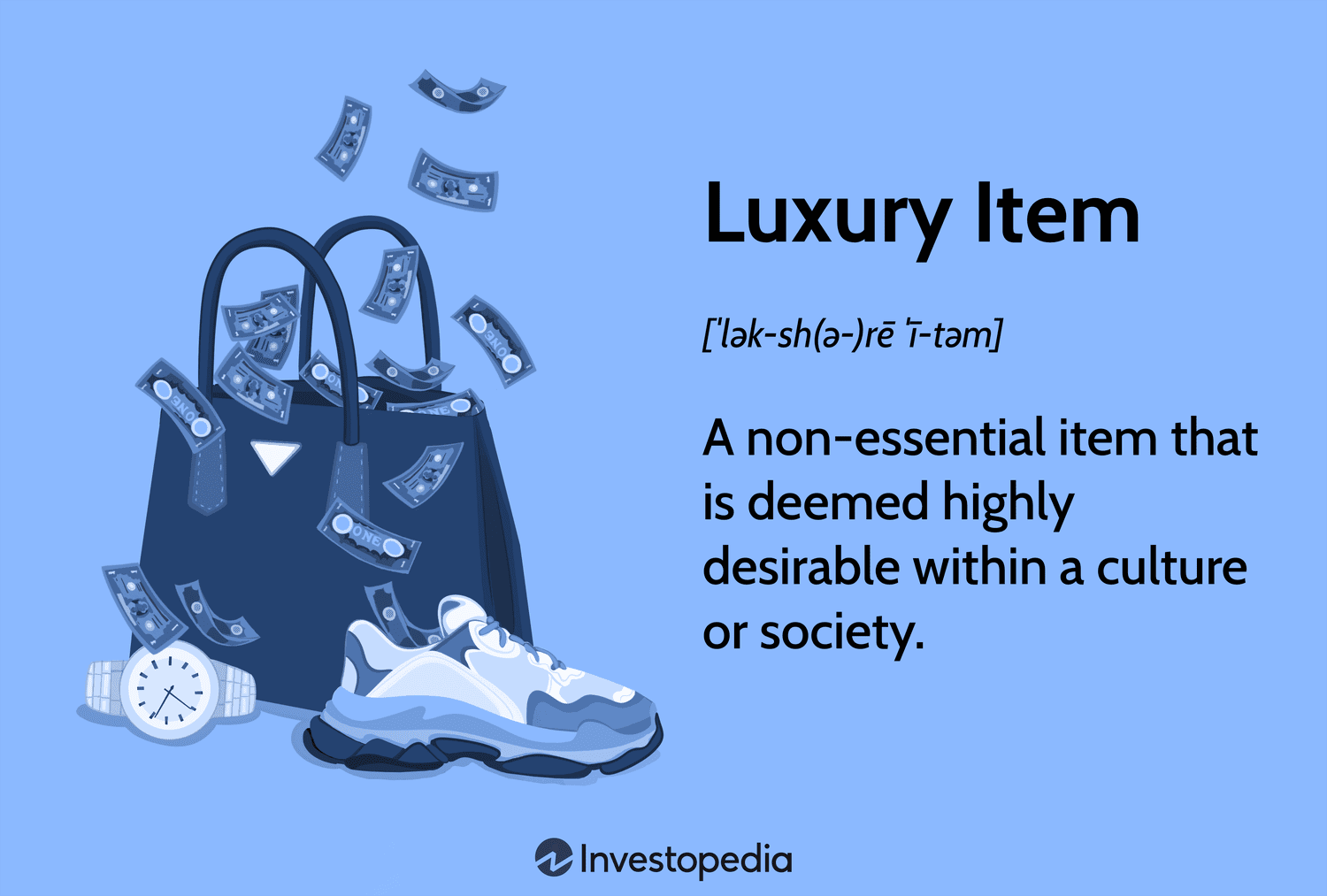
Beyond the formula, luxury goods exhibit distinct behavioral and market characteristics. These traits help identify them in the real world, even before crunching the numbers.
1. HIGH INCOME ELASTICITY OF DEMAND: As established, this is the defining trait. Demand accelerates faster than income growth.
2. PRESTIGE AND STATUS SIGNALING: Luxury goods often serve as Veblen goods, where their high price is part of their appeal. Ownership signals social status, success, and taste. The desire for them can sometimes increase as the price rises, defying the standard law of demand.
3. SUPERIOR QUALITY AND CRAFTSMANSHIP: They are typically associated with exceptional materials, design, and artisanry. This perceived quality justifies the premium price point.
4. BRAND HERITAGE AND EXCLUSIVITY: A powerful, often historical, brand narrative is common. Scarcity—whether real or perceived—is carefully managed to maintain desirability and high margins.
5. INESSENTIAL NATURE: Luxury goods are not required for basic survival or well-being. They cater to desires rather than needs, placing them at the top of a consumer’s spending hierarchy.
## Luxury Goods vs. Necessities vs. Normal Goods: A Clear Comparison
It is easy to confuse these categories. The table below clarifies the key differences based on economic behavior.
| Good Type | Income Elasticity of Demand | Demand Response to Income Rise | Examples |
|---|---|---|---|
| Necessity (Inferior Good) | Less than 0 | Demand DECREASES as income rises | Generic canned food, budget public transport |
| Necessity (Normal Good) | Between 0 and 1 | Demand increases SLOWER than income | Staple groceries, utilities, basic clothing |
| Normal Good | Around 1 | Demand increases PROPORTIONALLY to income | Quality groceries, family restaurant meals |
| LUXURY GOOD | Greater than 1 | Demand increases FASTER than income | Designer handbags, luxury cars, fine jewelry, high-end travel |
## The Veblen Effect: When High Price Drives Demand
A fascinating twist in the definition of luxury goods in economics is the Veblen Effect. Named after economist Thorstein Veblen, this phenomenon occurs when the demand for a good increases because its price is high. This directly contradicts the fundamental law of demand. For certain ultra-luxury items—like exclusive Swiss watches or haute couture—the exorbitant price itself is a core feature. It acts as a conspicuous signal of wealth. If the price were to drop significantly, the item might lose its appeal to its target market because it would no longer serve as an effective status symbol. This effect blurs the line between luxury goods and what are formally called “Veblen goods,” though there is significant overlap.
## How to Analyze a Product Using the Economic Definition: A 5-Step Guide
You can apply the economic principles yourself to evaluate any product or service. Here is a practical, step-by-step guide.
STEP 1: GATHER INCOME AND DEMAND DATA. Look for historical data on household incomes and sales figures for the product in a specific region. Macroeconomic databases or industry reports are good sources.
STEP 2: CALCULATE PERCENTAGE CHANGES. Calculate the percentage change in average income over a period and the percentage change in the quantity of the product demanded over the same period.
STEP 3: APPLY THE ELASTICITY FORMULA. Divide the percentage change in quantity demanded by the percentage change in income. The formula is: Income Elasticity = (% Change in Quantity Demanded) / (% Change in Income).
STEP 4: INTERPRET THE RESULT. If your result is a number clearly above 1 (e.g., 1.8), it suggests luxury good traits. A number near or below 1 indicates a normal good or necessity.
STEP 5: EVALUATE QUALITATIVE FACTORS. Cross-reference your number with the qualitative characteristics. Does the product have a strong brand? Is it used for status signaling? This confirms your quantitative finding.
## Common Misconceptions and Warnings
A major mistake is equating “expensive” with “luxury” in the economic sense. A high price alone does not define a luxury good. For instance, a critically needed prescription drug may be extremely expensive, but its demand does not skyrocket when people get richer; it is a necessity with an inelastic demand. Another warning: the classification of a good can change over time or vary between markets. In a developed economy, a car is a normal good. In an emerging economy, the first family car may be a luxury good. Furthermore, technological disruption can turn a luxury into a commonplace item. Mobile phones once fit the definition of luxury goods in economics but are now considered normal goods or even necessities in most parts of the world.
## The Global Luxury Market: Data and Trends
The practical application of this definition is seen in the massive global luxury market. According to Bain & Company’s 2023 Luxury Study, the personal luxury goods market reached approximately 1.5 trillion euros globally. (来源: Bain & Company, “Luxury Goods Worldwide Market Study, Fall-Winter 2023”). This market is highly sensitive to global income trends. For example, during economic booms in Asia, demand for European luxury brands surged, perfectly illustrating the high income elasticity principle. Interestingly, the report also highlights the growing importance of experiential luxury—high-end travel and dining—which also fits the economic model. From my experience analyzing market shifts, we have observed that true luxury brands maintain their elasticity by constantly innovating on exclusivity and experience, not just on product.
## The Future of Luxury: Sustainability and Digital Goods
The definition of luxury goods in economics is evolving. Two key trends are reshaping the landscape. First, sustainable and ethical luxury is becoming a powerful driver. For a new generation of high-income consumers, the “prestige” is increasingly tied to positive environmental and social impact. Second, the rise of digital luxury goods, like high-value NFTs or exclusive digital fashion, presents a new frontier. These items exhibit classic luxury characteristics: they are non-essential, have high income elasticity (targeting wealthy crypto investors), and serve as status signals in digital communities. They challenge traditional notions but fit neatly into the economic framework.
## Your Practical Checklist for Identifying Economic Luxury Goods
Use this checklist to evaluate any product or service against the rigorous economic definition.
INCOME ELASTICITY CHECK: Confirm demand grows significantly faster than average income growth.
STATUS SIGNALING TEST: Ask if ownership is primarily about functional utility or about social signaling and prestige.
PRICE-QUALITY NEXUS: Assess if the product commands a price premium far beyond functional equivalents due to perceived quality, craft, or brand.
NON-ESSENTIAL NATURE: Determine if the product is a want, not a need, for basic living standards.
BRAND STORY POWER: Evaluate the strength and exclusivity of the brand narrative and heritage.
MARKET CYCLE SENSITIVITY: Observe if sales are highly volatile and sensitive to economic boom and bust cycles.
Understanding the precise definition of luxury goods in economics provides a powerful lens for deciphering consumer behavior, forecasting market trends, and making informed business or investment decisions. It moves the conversation from subjective opinion to analyzable fact.