# The Ultimate Guide to Propane Prices in Ohio: How to Find the Best Rates and Save
If you are searching for propane prices in Ohio, you are likely looking for more than just a number. You want to understand the market, find a reliable supplier, and ultimately, save money on your home heating or agricultural fuel costs. This comprehensive guide dives deep into everything that influences propane costs in the Buckeye State and provides actionable strategies to secure the best possible price.
Understanding the factors behind propane price fluctuations is the first step to becoming a savvy consumer. Unlike electricity or natural gas delivered through fixed pipelines, propane is a commodity traded globally, and its local price is a complex equation.
KEY FACTORS INFLUENCING PROPANE PRICES IN OHIO
1. Crude Oil and Natural Gas Prices: Propane is a byproduct of both crude oil refining and natural gas processing. When the prices of these primary energy sources rise or fall, propane prices typically follow. For instance, geopolitical events that affect oil production can have a ripple effect on Ohio propane costs.
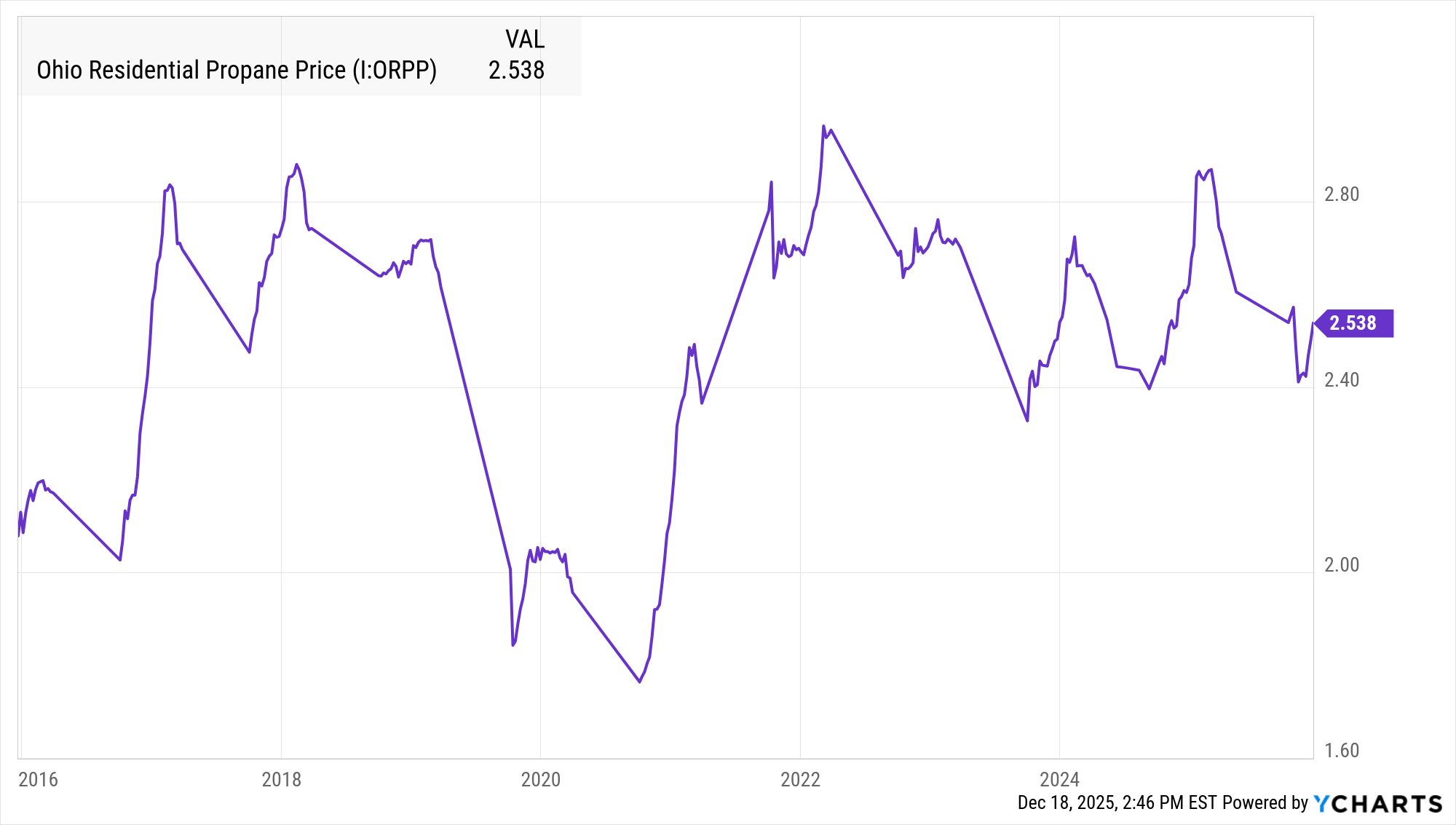
2. Supply and Demand Balance: This is the most direct factor. Demand spikes dramatically during cold winter months for heating. If a winter is particularly harsh in the Midwest, inventories can drop, and prices rise. Conversely, a mild winter often leads to lower prices.
3. Transportation and Logistics: Ohio’s proximity to major propane production and storage hubs in the Midwest, like Conway, Kansas, is generally an advantage. However, transportation costs still factor in. Delivery distance from a storage terminal to your local dealer affects your final price.
4. Local Market Competition: The number of propane suppliers in your specific county or region plays a huge role. Areas with only one or two providers may see less competitive pricing than urban or suburban areas with multiple companies vying for business.
According to the U.S. Energy Information Administration (EIA), residential propane prices in the Midwest, which includes Ohio, can vary by over 50 cents per gallon from one year to the next based on winter weather patterns and inventory levels (source: U.S. Energy Information Administration).
HOW OHIO PROPANE PRICING MODELS WORK
Not all propane companies charge the same way. Understanding these models is crucial for comparison.
| Pricing Model | How It Works | Best For | Potential Risk |
|---|---|---|---|
| Market Price (Variable) | You pay the current per-gallon rate each time you get a delivery. This rate changes with the wholesale market. | Customers who believe prices will fall and want no long-term commitment. | Prices can spike unexpectedly during high-demand periods, leading to very high bills. |
| Pre-Buy Contract | You lock in a fixed price per gallon for a set amount of propane (e.g., your estimated annual usage) before the heating season. | Budget-conscious customers who want price certainty and believe prices will rise. | If market prices fall below your locked-in rate, you will have overpaid. |
| Cap Price Program | A hybrid model. Your price fluctuates with the market but will never exceed a predetermined “cap” price per gallon. | Customers who want protection from extreme price spikes but also want to benefit if prices drop. | Usually involves a small upfront fee for the cap protection. |
A STEP-BY-STEP GUIDE TO GETTING THE BEST PROPANE PRICE IN OHIO
Follow this five-step process to ensure you are not overpaying for your propane.
STEP 1: AUDIT YOUR CURRENT USAGE AND CONTRACT
Pull out your last 12 months of propane bills. Calculate your total gallons used and your average price per gallon. Check if you are on a variable, pre-buy, or cap plan. Note your contract end date, as there may be fees for switching suppliers mid-contract.
STEP 2: RESEARCH LOCAL PROPANE SUPPLIERS
Compile a list of at least 3-5 licensed propane dealers serving your ZIP code. Use online searches, local business directories, and ask neighbors for recommendations. Do not limit yourself to just the big national companies; local family-owned dealers can sometimes offer more competitive rates and personalized service.
STEP 3: GATHER COMPREHENSIVE QUOTES
Contact each supplier. Ask for their current price per gallon AND a detailed breakdown of all their pricing plans (variable, pre-buy, cap). Crucially, ask about all additional fees: delivery charges, tank rental fees (if you do not own your tank), minimum usage fees, and service contract costs. A low per-gallon rate can be negated by high ancillary fees.
STEP 4: NEGOTIATE AND COMPARE
With your quotes in hand, you can often negotiate. Mention a competitor’s lower rate or offer to sign a pre-buy contract for a better price. Use the table above to understand which pricing model aligns with your budget and risk tolerance. Compare the total estimated annual cost, not just the per-gallon sticker price.
STEP 5: OPTIMIZE FOR LONG-TERM SAVINGS
Once you choose a supplier, focus on efficiency. Schedule a professional tune-up for your furnace or boiler. Ensure your home is well-insulated. Consider installing a programmable thermostat. These steps reduce your overall consumption, which is the most effective way to lower your annual propane bill.
COMMON MISTAKES TO AVOID WHEN SHOPPING FOR PROPANE
WARNING: AVOID THESE COSTLY PITFALLS
One of the biggest mistakes homeowners make is focusing solely on the per-gallon price advertised on a company’s website or truck. This is rarely the full story. Always ask for the “total delivered price” including all fees. Another critical error is waiting until your tank is nearly empty in the middle of a January cold snap to call for a delivery. Prices are highest when demand is highest. Plan your fills for the shoulder seasons—late fall or early spring—when demand is lower. Finally, do not ignore tank ownership. If you rent your tank from a supplier, you are often locked into buying propane only from them. Purchasing your own tank (or owning it outright) gives you the freedom to shop around every year, which can lead to significant long-term savings. According to my experience in the energy sector, we have seen clients reduce their annual fuel costs by 15-20% simply by switching from a tank rental program to owning their tank and becoming a free-agent customer.
FREQUENTLY ASKED QUESTIONS ABOUT PROPANE IN OHIO
Q: WHAT IS THE AVERAGE PROPANE PRICE IN OHIO RIGHT NOW?
A: Propane prices change daily. For the most accurate current average, check the weekly Ohio propane price reports from the U.S. Energy Information Administration (EIA) or the Ohio Propane Gas Association. Remember, your local price will vary.
Q: IS IT CHEAPER TO BUY PROPANE IN THE SUMMER?
A: Often, yes. Wholesale propane prices tend to be lower in summer due to low demand for heating. This is the ideal time to consider a pre-buy contract or to fill your tank if you have storage.
Q: CAN I SWITCH PROPANE COMPANIES IF I HAVE A LEASED TANK?
A: Typically, no. If your tank is leased or rented from your current supplier, it is their property. To switch, you would need to have the new company install their own tank (incurring a new rental fee) or you would need to purchase a tank yourself. Review your lease agreement carefully.
Q: ARE THERE ANY STATE PROGRAMS TO HELP WITH HEATING COSTS?
A: Yes. Ohio offers the Home Energy Assistance Program (HEAP), which provides financial assistance to eligible low-income households for paying their heating bills, including propane. Contact the Ohio Development Services Agency for details.
YOUR PROPANE SAVINGS CHECKLIST
To secure the best propane prices in Ohio, complete these actions before the next heating season.
– Review your past year’s propane bills and calculate your average cost per gallon.
– Identify the end date of your current supply contract, if any.
– Create a list of at least three local propane suppliers.
– Contact each supplier for a full quote including all fees and pricing plan options.
– Inquire about current pre-buy contract offers and their terms.
– Ask about tank rental fees and the cost to own your tank.
– Schedule a maintenance check for your propane heating system.
– Assess and improve your home’s insulation in key areas like attics and basements.
– Apply for energy assistance programs like HEAP if you are eligible.
– Plan your major propane fill for early fall or late spring.
By taking a proactive and informed approach, you can navigate the propane market in Ohio with confidence. Understanding the drivers of cost, comparing your options thoroughly, and focusing on overall efficiency will put you in control of your energy budget for years to come.