





Understanding the economic pulse of a nation often starts with a single, powerful number: its per capita income. For India, a country of immense diversity and rapid growth, this figure is more than just a statistic. It is a story of progress, disparity, and potential. This guide dives deep into the Indian income per capita, explaining what it means, how it is calculated, and what the current trends reveal about the world’s most populous democracy.
# What is Indian Per Capita Income?
Indian per capita income, often called Per Capita Net National Income (NNI), is a key economic indicator. It represents the average income earned per person in the country over a specific period, usually a financial year. It is calculated by dividing the country’s total Net National Income by its total population. This gives us a rough estimate of the economic well-being of the average citizen if the national income were distributed equally. However, it is crucial to remember that this is an average. It does not reflect the actual distribution of wealth, which in India, like many nations, is highly uneven. The term is often used interchangeably with GDP per capita, though there are technical differences. GDP per capita divides the Gross Domestic Product by population, while NNI per capita accounts for depreciation and net income from abroad, offering a slightly more accurate picture of income available to residents.
# How is India’s Per Capita Income Calculated?
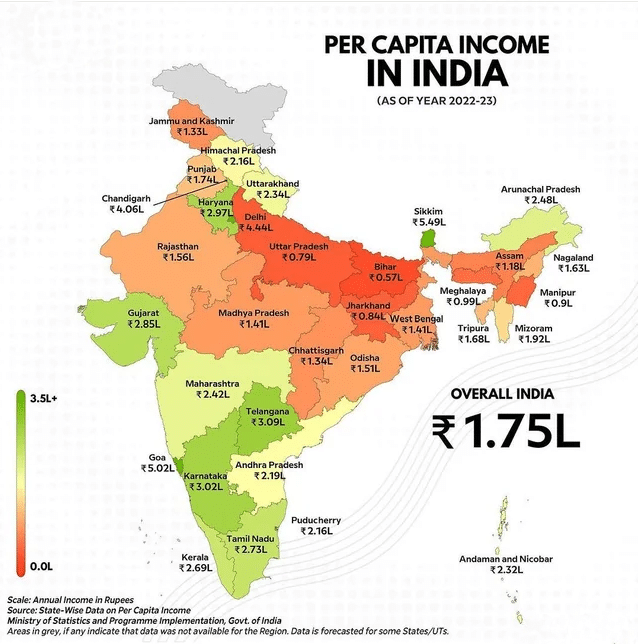
The calculation follows a standardized method by the Ministry of Statistics and Programme Implementation (MoSPI). First, economists calculate the Net National Income at current prices. This figure includes the total value of goods and services produced within the country (GDP), plus net factor income from abroad, minus depreciation of capital assets. This final NNI number is then divided by the country’s projected mid-year population. The result is the per capita income at current prices, which includes the effect of inflation. To understand real growth, economists also calculate it at constant prices, adjusting for inflation to show true income growth over time. For the financial year 2022-23, India’s per capita NNI at current prices was reported at Rs 172,000 (approximately $2,100). This marked a significant nominal increase, though real growth adjusted for inflation was more modest.
# Current State and Historical Trends of Indian Income Per Capita
India’s journey in raising its average income is a tale of accelerating growth. For decades, the increase was slow. A major turning point came with the economic liberalization reforms of 1991. Since then, the trajectory has been upward, though not without fluctuations. The past two decades have seen a more pronounced climb. According to government data, the per capita income has more than doubled in nominal terms over the last ten years. However, this growth must be contextualized. The COVID-19 pandemic caused a sharp dip in 2020-21, breaking a long growth streak. The recovery has been robust, with the economy bouncing back strongly. A key trend is the gradual shift from a primarily agrarian income base to one driven more by services and, increasingly, manufacturing. This structural change is fundamental to sustaining future income growth.
# The Stark Reality: Per Capita Income vs. Income Inequality
Here lies the most critical nuance in understanding Indian economic data. The national average income paints a picture of steady advancement. Yet, beneath this average lies a landscape of profound inequality. India has one of the highest levels of income inequality among major economies. A small percentage of the population commands a disproportionately large share of the national wealth. This means that for a vast majority of Indians, the actual income is far below the reported per capita figure. The gap between urban and rural incomes remains wide, and disparities exist across states, genders, and social groups. Therefore, while a rising per capita income is a positive macro sign, it does not automatically translate into improved living standards for all. Policymakers face the dual challenge of growing the pie and ensuring it is distributed more fairly.
# How Does India Compare Globally?
On the global stage, India’s position reflects its status as a lower-middle-income economy with high growth potential. According to World Bank data, India’s GDP per capita (a similar metric) places it in the ranks of nations like Bangladesh, Kenya, and Uzbekistan. It remains significantly below the global average and far behind developed economies like the United States, Germany, or even regional peers like China and Thailand. However, the growth rate is a different story. India is consistently among the fastest-growing major economies in the world. If this growth momentum is sustained, it is projected to move up the global per capita income rankings in the coming decades. The comparison highlights both the distance to be covered and the progress being made.
| Metric | India (2022-23 Est.) | China (2022 Est.) | United States (2022 Est.) |
|---|---|---|---|
| GDP Per Capita (Nominal USD) | ~$2,400 | ~$12,700 | ~$76,400 |
| Annual Growth Rate (Avg. last 5 yrs) | ~3-5% (real) | ~5-6% (real) | ~1-2% (real) |
| Primary Economic Drivers | Services, Agriculture, Manufacturing | Manufacturing, Tech, Exports | Services, Tech, Finance |
| Key Income Challenge | High Inequality, Rural-Urban Divide | Demographic Shift, Debt | Stagnant Middle-Class Wages |
# A 5-Step Guide to Analyzing Per Capita Income Data for Your Research
Whether you are a student, investor, or policy enthusiast, correctly interpreting per capita income data is crucial. Follow this practical guide.
STEP 1: ALWAYS CHECK THE PRICE BASE. Determine if the data is at “current prices” (nominal, includes inflation) or “constant prices” (real, inflation-adjusted). For understanding true growth, constant price data is essential.
STEP 2: IDENTIFY THE SOURCE AND METRIC. Confirm the source (e.g., MoSPI, World Bank, IMF) and the exact metric (NNI per capita, GDP per capita, GNI per capita). Different organizations use slightly different methodologies.
STEP 3: CONTEXTUALIZE WITH POPULATION GROWTH. India’s population is still growing. A rise in per capita income could be due to the economy growing faster than the population. Compare income growth rates with population growth rates.
STEP 4: SEEK SUPPLEMENTARY INEQUALITY DATA. Never rely on the average alone. Look for related data on the Gini coefficient (an inequality measure), poverty rates, and median income surveys to get a fuller picture.
STEP 5: COMPARE ACROSS TIME AND PEERS. Analyze trends over at least a 10-year period to smooth out short-term volatility. Then, compare India’s figures and growth rates with peer nations and regional benchmarks.
# Common Misconceptions and Pitfalls to Avoid
WARNING: A HIGH PER CAPITA INCOME DOES NOT MEAN UNIVERSAL PROSPERITY. This is the most common and dangerous misconception. As discussed, averages mask deep inequalities. A country can have a respectable average while millions live in poverty.
Another pitfall is confusing nominal and real values. Headlines often report impressive nominal jumps. For instance, a 10% nominal increase might only be a 4-5% real increase after accounting for 5-6% inflation. Always dig for the real growth figure.
Finally, avoid using per capita income as the sole measure of development. It is an economic measure, not a holistic well-being index. It does not account for factors like healthcare access, education quality, environmental sustainability, or happiness. According to my experience analyzing economic reports, a comprehensive view always combines income data with social and human development indices.
# The Future Trajectory: What’s Next for Average Income in India?
The future of India’s per capita income hinges on several interconnected factors. Sustained high economic growth is the primary engine. This requires continued investment in infrastructure, a stable policy environment, and boosting manufacturing through initiatives like “Make in India.” However, growth alone is insufficient. Enhancing human capital through better education and healthcare is critical to improving productivity, which directly feeds into higher wages and incomes. Furthermore, creating more formal, high-quality jobs is essential to translate aggregate growth into individual income gains. Technological adoption and the green energy transition present both challenges and opportunities for income generation. Most experts agree that if India can maintain its growth momentum while addressing inequality and skill development, the trajectory for its average income will remain strongly positive.
CHECKLIST FOR UNDERSTANDING INDIAN PER CAPITA INCOME
– Distinguish between nominal (current prices) and real (constant prices) income figures.
– Remember that per capita income is an average that hides significant wealth and income inequality.
– Compare India’s figures with both global averages and peer group nations for context.
– Always supplement income data with metrics on poverty, inequality (Gini index), and median income.
– Track long-term trends (10+ years) rather than focusing on single-year changes.
– Consider per capita income as one part of a broader assessment that includes human development indicators.
– Factor in population growth rates when analyzing changes in per capita income over time.
– Identify the primary sources of data, such as the Indian Ministry of Statistics or the World Bank.