





# The Ultimate Guide to the Value Chain in the Automobile Industry: Analysis, Breakdown, and Optimization
Understanding the value chain in automobile industry is not just an academic exercise. It is the fundamental blueprint for how a car goes from a raw idea to a product in your driveway. For executives, investors, and anyone involved in this complex sector, mastering this concept reveals where profits are made, where risks lie, and where the future of mobility is being shaped. This guide provides a deep, actionable analysis of the automotive value chain, breaking down each link and offering insights for optimization.
At its core, the automotive value chain describes the full range of activities required to bring a vehicle from concept, through design, sourcing, manufacturing, marketing, and finally to the end customer. It is a model for understanding how value is added at each step. In an era defined by electric vehicles, software-defined cars, and intense global competition, mapping and optimizing this chain is more critical than ever.
## What is the Automotive Value Chain? A Foundational Model
The concept of the value chain was popularized by Michael Porter. It views a company as a series of processes, each adding value to the final product. For automakers, this chain is exceptionally long and interconnected, involving thousands of suppliers across the globe. We can broadly categorize these activities into two groups: primary activities and support activities.
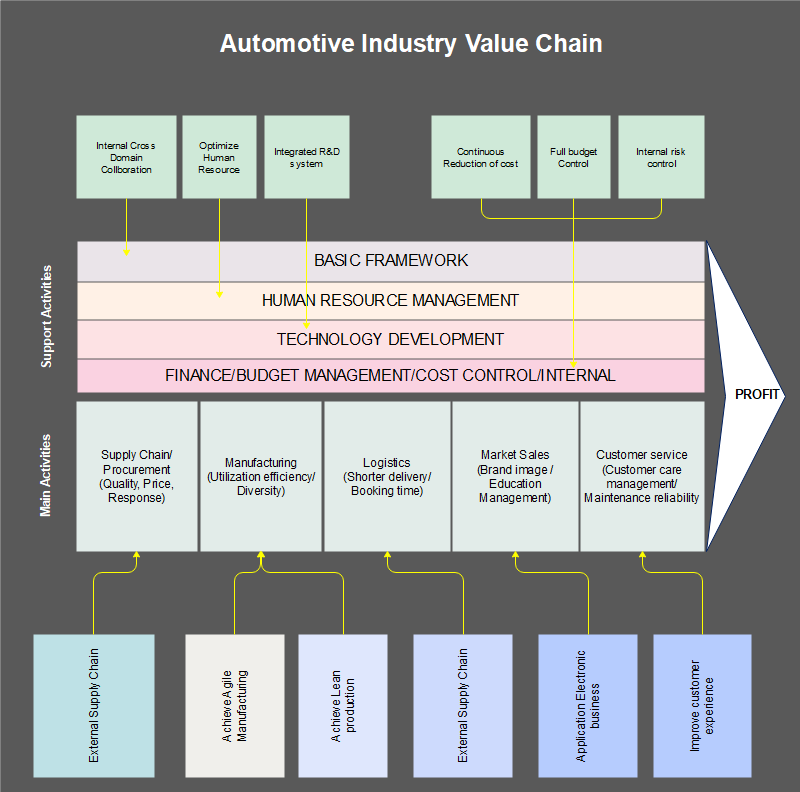
Primary activities are the direct steps in creating and selling the car. Support activities, like human resources and technology development, enable the primary activities to function efficiently. The entire structure of the automobile manufacturing ecosystem rests on this framework. A disruption in one link, as seen during the semiconductor shortage, can ripple through the entire chain, halting production worldwide. (来源: [AlixPartners, 2021 Global Automotive Outlook])
## A Detailed Breakdown of the Primary Activities
Let us walk through the primary links in the chain. This is where the physical and commercial transformation happens.
INBOUND LOGISTICS: This involves receiving, storing, and distributing the raw materials and components needed for production. For an automaker, this means managing a colossal flow of steel, aluminum, plastics, electronics, and thousands of pre-assembled parts like seats and dashboards from Tier-1 suppliers. Efficiency here is about just-in-time delivery and inventory cost reduction.
OPERATIONS: This is the core of manufacturing. It encompasses the entire assembly process where components are transformed into a finished vehicle. This includes stamping, welding, painting, and final assembly. Robotics and automation dominate this stage. The goal is to maximize throughput and quality while minimizing waste and defects.
OUTBOUND LOGISTICS: Once the car rolls off the line, it must get to the customer. This stage covers the distribution network, including transportation to dealerships via truck, rail, or ship, and inventory management at these locations. The challenge is balancing delivery speed with logistics cost.
MARKETING AND SALES: This activity generates demand and facilitates the purchase. It includes advertising, promotions, pricing strategy, dealer management, and the sales process itself. The rise of online car configurators and direct-to-consumer sales models, especially among EV startups, is dramatically reshaping this link.
SERVICE: The value chain does not end at the sale. After-sales service, maintenance, repairs, warranty work, and parts distribution are crucial for customer retention and long-term profitability. This segment often provides higher margins than new car sales for traditional dealerships.
## The Critical Role of Support Activities
These activities do not directly touch the product but are essential for the primary chain to operate. They provide the foundation.
FIRM INFRASTRUCTURE: This includes overall management, planning, finance, accounting, and quality control systems. Strategic decisions made here affect the entire chain.
HUMAN RESOURCE MANAGEMENT: Recruiting, training, and retaining skilled talent for engineering, factory floors, and management is a massive undertaking. The shift to EVs and software requires entirely new skill sets.
TECHNOLOGY DEVELOPMENT: This is arguably the most dynamic area today. It is not just about vehicle engineering. It encompasses research and development in batteries, autonomous driving software, connectivity, and manufacturing process innovation. According to a PwC analysis, software could account for up to 60 of the value creation in vehicles by 2030. (来源: [PwC, Software-driven car report])
PROCUREMENT: This is the process of sourcing all the goods and services needed for the primary activities. It involves negotiating with a vast network of suppliers, from raw material providers to complex subsystem manufacturers.
## The Modern Disruptors: EVs, Software, and Vertical Integration
The traditional automotive value chain is under immense pressure from new forces. The electric vehicle revolution simplifies the powertrain but massively increases the importance of the battery. Consequently, battery production and raw material sourcing (like lithium and cobalt) have become strategically paramount, leading companies to vertically integrate.
Furthermore, the car is becoming a software platform. This introduces a new, high-value link focused on software development, data management, over-the-air updates, and digital services. This shift is redistributing value away from traditional hardware manufacturing toward software and electronics.
Here is a comparison of how value chain priorities differ between a traditional automaker and a modern EV-centric OEM:
| Value Chain Activity | Traditional Automaker Focus | Modern EV OEM Focus |
|---|---|---|
| Inbound Logistics | Engine/transmission parts, metal alloys | Battery cells, semiconductors, software modules |
| Operations | Internal combustion engine assembly | Battery pack integration, software flashing |
| Technology Development | Combustion efficiency, lightweight materials | Battery chemistry, autonomous driving AI, user interface |
| Procurement | Global supplier network for hardware | Strategic partnerships for chips & batteries; in-house software |
| Service | Scheduled maintenance (oil changes, etc.) | Software updates, battery health monitoring |
## How to Analyze and Optimize Your Position in the Chain
Whether you are an automaker, a supplier, or an investor, you need a strategy. Here is a practical, five-step guide to analyzing your role within the automotive value chain.
STEP 1: MAP YOUR SEGMENT. Precisely identify which primary or support activity your business operates in. Are you in raw material supply (e.g., lithium mining), advanced component manufacturing (e.g., sensor production), or software development?
STEP 2: IDENTIFY DIRECT LINKS. Chart your immediate customers and suppliers. Understand their needs and pain points. How dependent are you on them, and they on you?
STEP 3: ANALYZE COST DRIVERS. Break down your costs for your segment. What are the major inputs? Where are the inefficiencies? For example, in logistics, is it fuel, delays, or inventory holding costs?
STEP 4: ASSESS VALUE ADDED. Critically evaluate what unique value you provide that allows you to command your price. Is it technological innovation, scale, reliability, or brand?
STEP 5: SCAN FOR DISRUPTION. Continuously monitor trends like electrification, autonomy, and new business models (e.g., car subscriptions). Assess how these trends could make your link more valuable, redundant, or in need of transformation.
Based on my experience consulting with auto suppliers, I have seen companies fail at Step 4. They focus solely on cost-cutting but neglect to innovate their value proposition, making them vulnerable to cheaper competitors. The winners are those who embed themselves as indispensable partners through technology.
## Common Pitfalls and Strategic Warnings
A misunderstanding of the value chain can lead to poor strategic decisions. Here is a crucial warning section.
WARNING: DO NOT CONFUSE LOW COST WITH HIGH VALUE. A component may be cheap to produce, but if it is critical to safety or performance, its strategic value is high. Conversely, a high-cost process that customers do not value should be a target for elimination or outsourcing.
WARNING: BEWARE OF VERTICAL INTEGRATION TRAPS. While controlling more of the chain seems appealing, it requires massive capital and expertise. An automaker making its own seats might save money but lose access to a specialist supplier’s innovation. The decision to “make or buy” must be based on core competency.
WARNING: OVERLOOKING THE DIGITAL THREAD. In today’s industry, the physical and digital value chains are merging. Data flows from vehicle usage back to R&D are creating a closed-loop system. Companies that treat software and data as an afterthought are building a chain with a weak link.
## Your Automotive Value Chain Optimization Checklist
To conclude, here is a practical checklist to evaluate and strengthen your position within the automobile industry value chain. Use this as a starting point for strategic review.
– Map your exact position within the primary and support activities.
– Identify your top three cost drivers and one opportunity for reduction.
– Define your unique value proposition in a single sentence.
– List two major industry trends that could disrupt your segment.
– Evaluate one key supplier relationship for strategic risk.
– Evaluate one key customer relationship for dependency risk.
– Assess your investment in software and digital capability versus industry benchmarks.
– Review your after-sales service model for recurring revenue potential.
– Conduct a scenario analysis on a critical raw material shortage.
– Establish a process for continuous value chain monitoring and review.
The value chain in automobile industry is not static. It is a living system evolving at breakneck speed. From the mine to the software update, every link is being tested and transformed. Success will belong to those who not only understand this chain but also have the agility to reshape their role within it. The journey from raw material to smart, connected vehicle is the story of modern industry, and its map is the value chain.