# The Ultimate Guide to the Non Excludable Goods Definition in Economics: 5 Key Insights
Understanding the non excludable goods definition in economics is crucial for grasping how societies manage shared resources and public services. This concept sits at the heart of public policy, environmental economics, and market analysis. If you have ever wondered why some things, like national defense or clean air, are provided by governments instead of private companies, you are thinking about non excludable goods.
In simple terms, a non excludable good is one where it is impossible, or extremely costly, to prevent individuals from using it, even if they do not pay for it. This characteristic leads to unique challenges and market failures. Our team has analyzed countless economic models and real world cases to bring you this comprehensive guide. We will break down the definition, explore its implications, and show you how this idea applies to your everyday life.
Let us dive into the economics of non excludability and uncover why it matters more than you might think.
## What Is the Core Non Excludable Goods Definition in Economics?
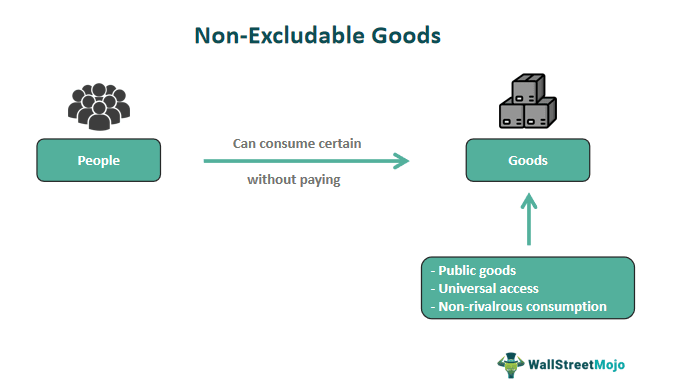
The formal non excludable goods definition in economics describes a type of good for which suppliers cannot easily exclude non payers from consumption. Once the good is provided, it is available for everyone. This is one of the two key characteristics that define public goods, the other being non rivalry.
Excludability is a matter of degree and technology. For instance, a radio broadcast is largely non excludable because anyone with a receiver can tune in. However, with satellite radio technology and encryption, companies can make it excludable. The classic, pure examples are national defense and street lighting. If a country is defended from attack, all residents benefit automatically. You cannot protect one house while leaving its neighbor vulnerable.
It is vital to distinguish this from the idea of non rivalry. A good is non rival if one person’s use does not diminish another’s. A non excludable good can be rival, leading to what is known as a common pool resource. Understanding this nuance is the first step in mastering the non excludable goods definition in economics.
## The Critical Difference: Non Excludable vs. Non Rivalrous Goods
Many people confuse non excludability with non rivalry. While they often appear together in pure public goods, they are distinct concepts with different economic implications. Clarifying this difference is essential.
NON EXCLUDABILITY focuses on the difficulty of preventing consumption. It is about the “free rider problem,” where people benefit without contributing. NON RIVALRY focuses on consumption itself. It asks whether my use of the good reduces the amount available for you.
Here is a simple HTML table to contrast these properties across different good types:
| Type of Good | Excludable? | Rivalrous? | Examples |
|---|---|---|---|
| Private Good | YES | YES | Food, clothing, a car |
| Club Good / Toll Good | YES | NO | Cinema, satellite TV, private park |
| Common Pool Resource | NO | YES | Fish in the ocean, public pasture, groundwater |
| Public Good (Pure) | NO | NO | National defense, public knowledge, air quality |
As the table shows, a common pool resource like a fishery is non excludable but rivalrous. Overfishing by one boat reduces the catch for others, leading to the “tragedy of the commons.” This is a direct result of the non excludable goods definition meeting rivalry.
## The Free Rider Problem: Why Markets Fail with Non Excludable Goods
The primary economic issue arising from the non excludable goods definition is the free rider problem. Since people cannot be excluded from benefiting, they have a strong incentive to let others pay for the good while they enjoy it for free. If everyone thinks this way, no one pays, and the good is not produced at all, even if society values it highly.
This is a clear market failure. Private firms have no profit motive to provide non excludable goods because they cannot charge users effectively. The market, left alone, will under provide or completely fail to provide these goods, despite their potential social value.
Consider public fireworks displays. A private company could try to sell tickets, but it is nearly impossible to stop people outside the ticketed area from watching the show. Anticipating this, few would buy tickets, and the company would go out of business. This is why most fireworks displays are funded by municipalities or through donations. The global underinvestment in basic scientific research is another consequence, as the benefits of knowledge are widely shared and non excludable. A 2021 report by the OECD noted that governments fund about 70% of basic research worldwide due to its public good characteristics (source: OECD Science, Technology and Innovation Outlook 2021).
## Real World Examples and Case Studies
The non excludable goods definition in economics is not just theoretical. It explains many real world phenomena and policy decisions.
Classic examples include lighthouses, often cited in economic textbooks. Historically, once a lighthouse beam is shining, it guides all ships in the vicinity, regardless of whether their owners contributed to its maintenance. This made private provision difficult. Interestingly, research by Nobel laureate Ronald Coase showed some lighthouses in England were privately funded through port fees, a clever workaround to the excludability problem.
Modern examples are everywhere in the digital world. Open source software like the Linux operating system is non excludable. Anyone can download, use, and modify it without paying. Its development is sustained by a community of contributors and corporate sponsors who benefit from the ecosystem. Public parks, uncongested roads, and disease prevention programs like vaccination also fit the non excludable goods definition. When a critical mass of people is vaccinated, herd immunity protects even those who are not vaccinated, creating a non excludable benefit.
## A 5 Step Guide to Analyzing Any Good for Excludability
How can you apply the non excludable goods definition in economics to analyze any product or service? Follow this practical, five step guide.
STEP 1: IDENTIFY THE GOOD. Be specific. Are you analyzing “a song” or “a digital MP3 file of a song”? The level of specificity changes the analysis.
STEP 2: ASK THE EXCLUSION QUESTION. Is it physically or institutionally possible to prevent someone from consuming this good if they do not pay? Consider the technology and legal frameworks available.
STEP 3: ASSESS THE COST OF EXCLUSION. Even if exclusion is technically possible, is it economically feasible? The cost of building a fence around a city park or encrypting a public radio signal may be prohibitively high.
STEP 4: DETERMINE RIVALRY. Separately, ask if one person’s consumption reduces the amount available for others. This will help you classify the good using the table above.
STEP 5: EVALUATE THE IMPLICATIONS. Based on your classification, predict the likely market outcome. Will private provision work? Is government intervention or community management needed?
COMMON MISCONCEPTION WARNING: A frequent error is assuming all government provided goods are non excludable. This is not true. Governments also provide excludable goods like driver’s licenses or public utilities where usage is metered and billed. The key is the good’s inherent characteristics, not who provides it.
## Solutions and Policy Interventions for Non Excludable Goods
Since markets often fail here, societies have developed several solutions to provide non excludable goods.
Government provision and taxation are the most direct. By using tax revenue, the government can fund national defense, basic research, and public infrastructure, overcoming the free rider problem by making payment compulsory.
Subsidies and patents offer a hybrid model. For goods with high social value, like new medicines, governments grant temporary patents (creating artificial excludability) to incentivize private research. They may also subsidize production or purchase.
Community management and social norms can work for local common pool resources. Elinor Ostrom’s Nobel winning work showed that communities can successfully manage fisheries, forests, and irrigation systems through trust, communication, and agreed upon rules, without privatization or government control.
Technological innovation can sometimes turn a non excludable good into an excludable one. Digital rights management (DRM) software attempts to make digital media excludable. Conversely, new technologies like cheap sensors can make monitoring usage of a common resource easier, enabling better management.
## The Future of Non Excludability in a Digital and Global World
The digital age is constantly reshaping the non excludable goods definition in economics. Data, digital content, and online networks present new challenges. Is a massive dataset non excludable? It can be, if it is leaked or publicly posted. Online security is a global public good; a vulnerability in one system can affect everyone.
Furthermore, climate change mitigation is the quintessential 21st century challenge involving non excludable goods. Stable climate is a global public good. Reducing emissions in one country benefits all, creating a massive free rider problem on an international scale. This makes global agreements like the Paris Accord both critically important and notoriously difficult to enforce. According to a 2023 analysis by the Climate Action Tracker, current global policies are still projected to lead to around 2.7°C of warming, highlighting the collective action dilemma (source: Climate Action Tracker).
## Your Practical Checklist for Non Excludable Goods
Use this checklist to identify and analyze non excludable goods in any context.
IDENTIFY THE CORE CHARACTERISTIC: Can non payers be easily prevented from using the good?
PREDICT THE MARKET OUTCOME: Expect under provision or no provision by private markets.
LOOK FOR FREE RIDERS: Identify who benefits without contributing.
CONSIDER THE POLICY RESPONSE: Is the good provided by government, managed by a community, or has technology enabled exclusion?
CLASSIFY WITH RIVALRY: Determine if it is a pure public good, a common pool resource, or another type.
ANALYZE REAL WORLD EXAMPLES: Practice by classifying things like podcasts, Wikipedia, or a public beach.
UNDERSTAND THE GLOBAL IMPACT: Recognize how issues like biodiversity loss and pandemic preparedness fit the definition.
Mastering the non excludable goods definition in economics provides a powerful lens to view everything from local community projects to the world’s most pressing issues. It explains why we collectively pay for some things and leave others to the market. By understanding excludability, you gain insight into the fundamental logic behind public policy and the intricate dance between individual incentives and societal well being.